
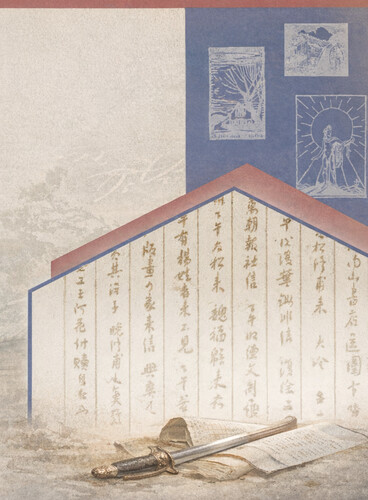
Success case
Exhibition Design: "Songs of Turbulent Times: Yu Dafu and Lu Xun"
China Museum of Modern Press and Publication
- Location
- Shanghai, China
- Duration
- September 18–December 17, 2025
Reframing Modern Literary Friendship Through Two Figures.
Tempest and Song: Lu Xun and Yu Dafu is a thematic exhibition on literary friendship presented by the Museum of Modern Chinese Press and Publishing. Centered on two major figures of modern Chinese literature, the exhibition brings together 54 precious letters and personal objects to trace their friendship, intellectual exchange, and mutual influence.
Marking the 80th anniversary of Yu Dafu’s death, it reconsiders their relationship as part of the broader history of modern Chinese literature. Within the context of the museum, the exhibition goes beyond a parallel presentation of two writers. It becomes a narrative about modern publishing, literary production, intellectual exchange, and public cultural memory.
Through documents, objects, and spatial storytelling, the project transforms their emotional and intellectual connection into an experience that visitors can read, sense, and relate to.
Highlights
- Centers on the literary friendship between Lu Xun and Yu Dafu
- Builds a two-figure narrative around relationship, exchange, and mutual influence
- Marks the 80th anniversary of Yu Dafu’s death, strengthening the exhibition’s commemorative and historical dimension
- Brings together 54 letters and personal objects to reconstruct their intellectual and personal connection
- Translates an abstract literary relationship into a more accessible public exhibition
•
Highlights
the links between literature, publishing, and modern cultural communication
- Uses personal connection as an entry point into the history of modern Chinese literature
Design Challenge
Unlike a single-person exhibition, the challenge of a two-figure show lies not in introducing each writer separately, but in making their relationship itself legible. Though Lu Xun and Yu Dafu differed in age, temperament, and intellectual orientation, they formed a deep and lasting bond.
The core challenge of this project was how to translate that relationship—marked by both difference and resonance—into a clear exhibition structure within a limited space. At the same time, literary exhibitions are naturally text-heavy. If reduced to biographical facts and works, the exhibition risks becoming a flat memorial display; if it leans too far into emotion, it may lose its place within literary and cultural history.
The design therefore needed to balance personal connection, historical context, and literary significance, so that visitors could understand not only that the two men were close, but why their friendship matters in the history of modern Chinese literature.
Design Strategy
The project is built on the idea of two figures in parallel, one relationship as narrative, shifting the exhibition from introducing two writers separately to understanding an era through their connection. Rather than treating Lu Xun and Yu Dafu as parallel biographies, the exhibition is organized around their encounter, intellectual exchange, literary resonance, and mutual recognition, creating a more dynamic narrative path into modern literature and its historical context.
Spatially, the design emphasizes the rhythm of a dual-figure structure. It preserves each writer’s distinct personality and literary identity, while using letters, images, texts, and key narrative moments to reveal how two individual trajectories intersected within the same era. In this way, the exhibition balances documentary grounding with emotional depth, allowing visitors to read both the relationship and the time through it.
Project Value
The value of this project lies in offering a more public-facing way to present literary relationships in exhibition form. Lu Xun and Yu Dafu are shown not simply as two canonical writers, but as a cultural link between modern literature, intellectual exchange, and public memory. By giving spatial form to their relationship, the exhibition helps visitors see literary history not only as a chronology of works and dates, but also as a history of human connection and shared spirit.
For the Museum of Modern Chinese Press and Publishing, the project also expands the possibilities of literary exhibition-making—from presenting a single writer to presenting a cultural relationship. In this way, it turns documents and personal objects into a more engaging and emotionally resonant reading of modern literary history.