
Success case
Guardians of Eternity – The Terracotta Warriors of the First Chinese Emperor
Fine Arts Museum Budapest
- Location
- Budapest, Hungary
- Duration
- 11/2025 - 05/2026
With the support of Back and Rosta Ltd, the Chinese Terracotta Army has arrived at the Museum of Fine Arts, Budapest.
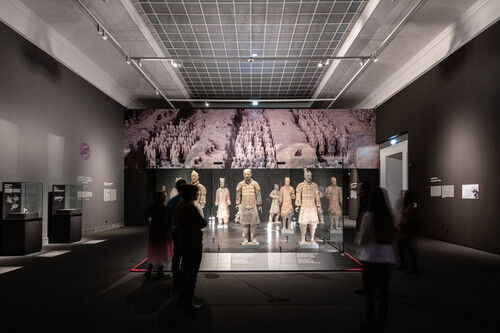
The exhibition, spanning more than a millennium, focuses on one of the world’s most famous archaeological finds: the Chinese terracotta army and the era of the first Chinese emperor. Organised with Back és Rosta Ltd., “Guardians of Eternity – The Terracotta Warriors of the First Chinese Emperor” displays more than 130 ancient artifacts, including ten original pieces from the first emperor’s terracotta army.
All of the objects come from museums in Shaanxi, the province that includes the former imperial capital of China. Most are from the Mausoleum Museum of the First Chinese Emperor, the Han Dynasty Yangling Imperial Tomb Museum, and the Shaanxi Provincial Institute of Archaeology.
Exhibition facts
- Object number: 130
- Venue size: 1,200 m²
Highlights
- Centres the narrative on Emperor Qin Shi Huang and the Terracotta Army as icons of early Chinese civilisation
- Connects empire-building, military order, and funerary belief
- Uses highly recognisable artefacts to make Chinese imperial history publicly readable
- Combines objects, images, documents, and multimedia
- Balances archaeological impact with historical interpretation
- Turns ancient imperial civilisation into a vivid cross-cultural exhibition experience
Project Challenges
The core challenge is how to use a collection of archaeological artefacts—visually striking and internationally recognised—as a point of entry, while still conveying the imperial system, historical context, and cultural concepts behind them.
The Terracotta Army naturally possesses a strong visual appeal; audiences are often first struck by its scale, imagery, and air of mystery. Its true significance, however, lies not merely in spectacle, but in the national order, hierarchical system, funerary practices, and concept of eternity it embodies.
For audiences in Budapest, Emperor Qin Shi Huang and the Terracotta Army hold the allure of a foreign civilisation, yet there is also a historical distance. The project must therefore balance on-site impact with historical interpretation, guiding visitors from “seeing the Terracotta Army” to “understanding the Qin Empire.”
Design Strategy
The project adopts “From Figurines to History, From Mausoleum to Empire” as the core logic of its exhibition design, positioning the Terracotta Army as the starting point—rather than the endpoint—of the narrative.
The exhibition unfolds across several layers: the empire, military formations, institutional systems, and the imagination of eternity. It begins with the Terracotta Army’s forms, craftsmanship, and formations, then expands to the historical context of Emperor Qin Shi Huang’s mausoleum, the political unification of the Qin Empire, its military organisation, and its spiritual beliefs.
In spatial expression, the design draws on the visual language of Qin-era military formations, mausoleum architecture, and artefact forms. Through spotlighting of key exhibits, a text-and-image system, multimedia aids, and lighting control, it creates an environment that combines solemnity, historical depth, and narrative tension. Static archaeological display becomes a multi-layered narrative of civilisation, so visitors enter the world of the Terracotta Army while immersing themselves in early Chinese imperial history.
Project Value
The significance of this project lies in establishing a cross-cultural pathway for the dissemination of ancient Chinese civilisation that is more accessible to the public, through a collection of highly iconic Chinese archaeological artefacts.
Within the framework of the Budapest Museum of Fine Arts, the Terracotta Army is no longer merely an Eastern marvel to be viewed, but a vital medium for understanding China’s state formation, historical order, and civilisational imagination.
Through the synergy of narrative, space, and media, the project transforms the exhibition of Chinese archaeological artefacts from a simple display of masterpieces into an understanding of civilisation, further expanding the expressive possibilities of international historical and cultural exhibitions in cross-cultural communication.