
Success case
Realm of Eternity: The Painting Practice of Hungarian Contemporary Artist Márta Kucsora
Yunnan Provincial Museum
- Location
- Kunming, China
- Duration
- February 14–May 10, 2026
Painting as Contemporary Dialogue.
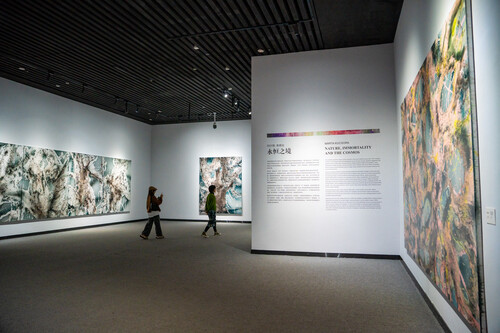
Eternal Realm: The Painting Practice of Hungarian Contemporary Artist Márta Kucsora is an international art exhibition presented by the Yunnan Provincial Museum in 2026. Featuring 74 works from over two decades of practice, the exhibition explores Kucsora’s ongoing investigation into material processes, spatial scale, and the forces of nature, presenting painting as a physical, temporal, and environmental act rather than simply image-making.
Within the context of the Yunnan Provincial Museum, the exhibition introduces not only the work of a Hungarian contemporary artist, but also a way of connecting international contemporary art with local viewing experience. Through large-scale paintings and immersive moving-image installations, the project opens up a broader dialogue on nature, space, bodily perception, and cross-cultural ways of seeing.
Highlights
- Centers on Márta Kucsora’s painting practice to explore contemporary art and perceptual experience
- Features 74 works at the Yunnan Provincial Museum, on view through early May 2026
- Presented as the artist’s first major systematic exhibition in China
- Focuses on the relationship between material process, spatial scale, and the forces of nature
- Combines large-scale paintings with immersive moving-image installations
- Expands painting from a flat visual medium into a more environmental and bodily experience
Design Challenge
The core challenge of this project was how to present the abstract material processes and spatial perception of contemporary painting within a museum context, and guide visitors from simply seeing the image to understanding painting as an event of formation. Márta Kucsora’s work relies less on narrative imagery than on the interaction of material, scale, force, and environment.
While visually powerful, such work asks viewers to move beyond conventional image-reading toward an understanding of painting’s materiality, generative logic, and spatial presence. For museum audiences, this creates both a fresh experience and a certain threshold of entry. At the same time, the exhibition also needed to respond to the public cultural context of the Yunnan Provincial Museum, balancing artistic integrity and curatorial depth with a more accessible and immersive viewing experience.
Design Strategy
The project is grounded in the idea of painting as a spatial practice in process, framing Márta Kucsora’s work through the relationships between material, scale, nature, and perception. Rather than presenting painting as a finished image, the exhibition emphasizes the artist’s long-term exploration of material formation, spatial scale, and natural forces.
This structure helps visitors move from the surface of the work to its underlying logic, understanding painting as a practice shaped by time, environment, and bodily perception. Spatially, the exhibition combines large-scale paintings with immersive moving-image installations to strengthen the relationship between the works and the gallery environment.
In this way, painting is transformed into an experiential spatial event, making Kucsora’s abstract visual language more accessible within the museum context.
Project Value
The significance of this project lies in creating a more open and perceptual mode of international art exhibition through the solo show of a Hungarian contemporary artist. Within the framework of the Yunnan Provincial Museum, Márta Kucsora’s work is presented not simply as imported international art, but as a medium connecting material practice, spatial experience, and cross-cultural viewing.
The exhibition invites visitors to see contemporary painting not only in terms of image, but also as a reorganization of natural force, bodily perception, and environment. Through the integration of painting, moving-image installation, and exhibition space, the project transforms contemporary art from an abstract professional discourse into a public cultural experience that can be physically sensed and spatially encountered.