
Success case
The Realm of Masters—Highlights from the Collection of the Hungarian National Gallery
Shenzhen International Museum of Art
- Location
- Shenzhen, China
- Duration
- 05/2026-08/2026
Starting with national-level European art collections, this exhibition will launch an international exploration of masterworks, national memories, and modern visual civilization. "The Realm of Masters: Treasures from the Hungarian National Gallery" is an important international art exchange exhibition held at the Shenzhen International Art Museum.
Drawing upon the core collections of the Museum of Fine Arts Budapest and the Hungarian National Gallery, the exhibition focuses on European masters and their representative works from the Renaissance onwards. Through paintings, sculptures, works on paper, pictorial documents, and multimedia displays, it systematically presents the continuation and transformation of the European art tradition, showcasing the rich visual landscape of civilization constructed by the masters' works amidst religious narratives, royal and courtly culture, historical memory, portrait traditions, landscape imagination, academic norms, and the transformation of modern aesthetics.
As one of the most culturally distinctive national art collections in Central Europe, the Hungarian National Gallery's collection not only records the development of Hungarian art but also reflects the profound changes in the social, intellectual, and aesthetic structures of modern Europe.
This exhibition will use "Masters" as a narrative entry point, connecting portraits, landscapes, historical paintings, scenes of daily life, and explorations in modern art, presenting how artists responded to the nation, land, memory, identity, and the spiritual world of humanity amidst the tides of time.
In the context of Chinese audiences, this exhibition is not only a concentrated presentation of works by European masters, but also a visual path to understanding Hungarian history and culture and the diversity of European art. With internationally acclaimed curatorial narrative and spatial expression, the exhibition guides Shenzhen audiences from classic works into a broader European art scene, establishing a multi-layered dialogue between artistic appreciation, historical interpretation, and cross-cultural understanding.
Therefore, the project not only showcases the important collections of Hungary's national art museums, but will also become an important exhibition practice for the Shenzhen International Art Museum to deepen international cultural exchanges and expand the influence of European art research and public art education.
The exhibition aims to strike a balance between the visual impact of masterpieces, the academic depth of national collections, and the public value of cross-cultural communication, transforming Hungarian art into an urban cultural event with historical depth, aesthetic tension, and international vision.
Highlights
- As an important international section in the Shenzhen International Art Museum's opening exhibition series, it showcases the new museum's international vision, academic positioning, and urban cultural aspirations.
- Centered on the collection of the Hungarian National Gallery, it presents an important visual lineage of the European art tradition after the Renaissance.
- Through masterpieces, religious narratives, court culture, historical memory, portrait traditions, landscape imagination, and modern aesthetic transformation are connected.
- The exhibition uses paintings, sculptures, works on paper, graphic documents, and multimedia content to construct a three-dimensional, immersive narrative.
- Establish a readable and engaging viewing path between classic works of art, interpretations of history and culture, and public aesthetic education.
- Transforming a national-level art collection into a grand opening exhibition that combines academic depth, aesthetic appeal, cross-cultural immersion, and international communication value.
Design Strategy
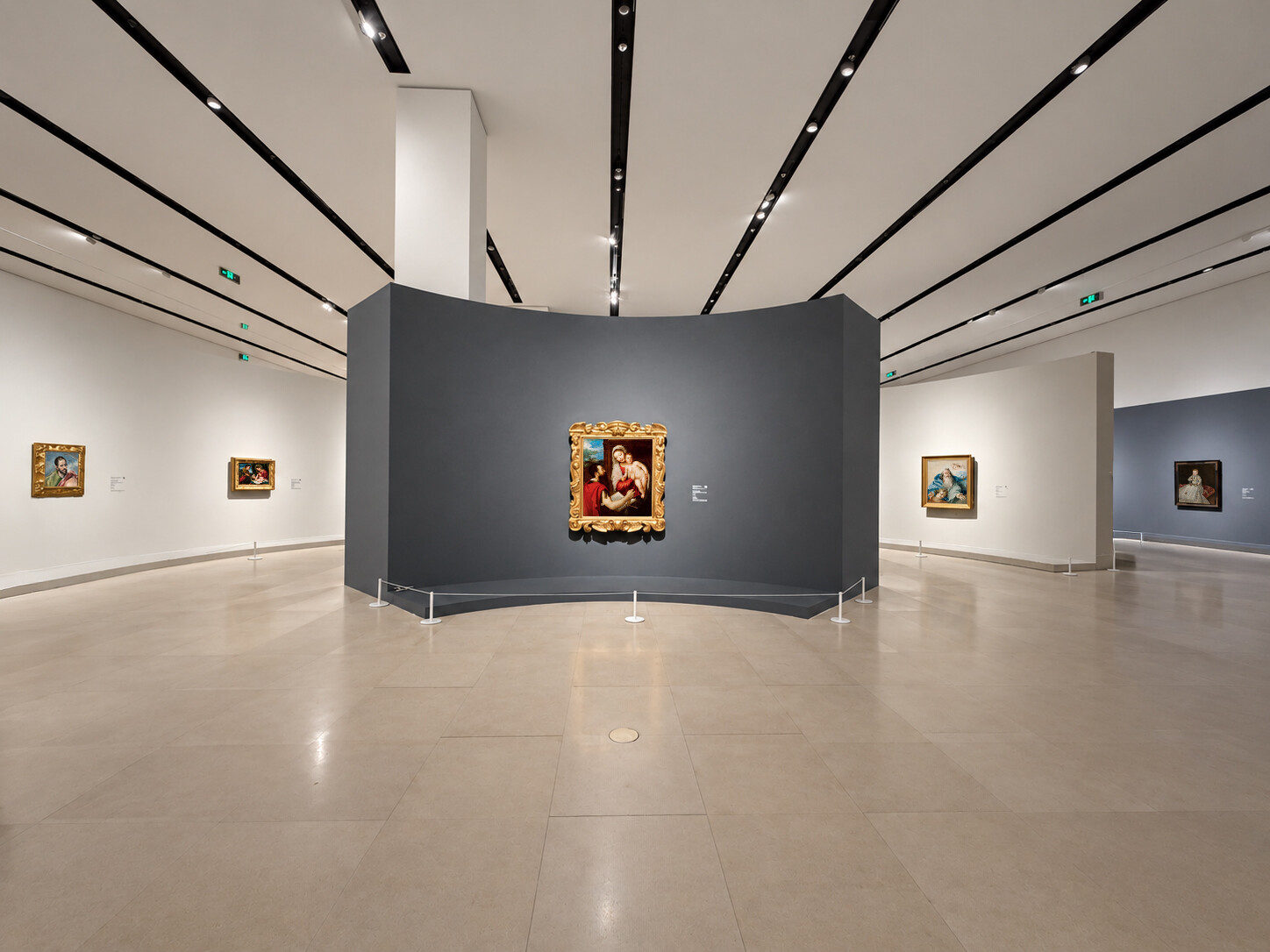
The project's core design logic is " to see the person through their works, and to observe the world through their art, " using masterpieces as the starting point of the exhibition's narrative rather than as isolated displays. The exhibition unfolds around several aspects, including tradition, the times, change, and individual expression.
It delves into the themes, forms, techniques, and visual language of the works, gradually extending to the artists' creative backgrounds, the historical changes in European society, the evolution of the academic system, and the formation of modern art concepts. In terms of spatial expression, the design extracts the sense of order and ritual from classic European architecture, art salons, and museums.
Through highlighting key works, an art history graphic system, multimedia support, and refined lighting control, it creates an exhibition environment that combines elegance, historical depth, and narrative tension. While maintaining an unified overall visual language, different exhibition units create rhythmic variations based on the era, artistic style, and spirit of the works, allowing visitors to experience the historical trajectory of European art's transformation from classical tradition to modernity as they move through the space.
In this way, the classic art exhibitions that were originally focused on individual works are transformed into a more layered art historical narrative, allowing the audience to appreciate the works of masters up close while gradually entering the spiritual world jointly constituted by European art traditions, contemporary culture, and individual creation.
Project Value
The significance of this project lies in establishing a more accessible and internationally-oriented path for disseminating Western art history through a collection of highly representative works by European masters. Within the framework of the opening exhibition at the Shenzhen International Art Museum, these masterpieces are no longer merely artistic classics to be admired and revered, but rather become important mediums for understanding the historical process, cultural traditions, aesthetic concepts, and humanistic spirit of Europe.
Through the synergy of narrative, space, and media, the project transforms the traditional display of masterpieces into a dialogue of civilization about art, the times, and humanity. While strengthening the professional positioning and international image of the Shenzhen International Art Museum, it also provides the public with an important platform to approach world art classics, understand European art history, and establish cross-cultural aesthetic experiences, further expanding the ways in which international art exhibitions can be expressed in urban public culture and cross-cultural communication.